
Looking for a Financial Planner Brisbane?
Choosing a financial planner is not like choosing a plumber. You are handing someone visibility over your income, your superannuation, your debts and your plans for the next thirty years — and the difference between good and poor advice compounds quietly for decades. It is worth taking the time to choose deliberately.
This guide covers what to check, what advice costs in Australia, and the questions worth asking before you commit to anyone. It is general information, not advice about your circumstances.
What a financial planner actually does
A financial planner helps you decide what to do with your money over time, and then implements those decisions. In practice that usually means some combination of superannuation and contribution strategy, retirement planning and Centrelink entitlements, personal insurance, investment and portfolio construction, cashflow and debt reduction, tax structuring, and estate planning.
What separates advice from information is that a licensed adviser must consider your specific objectives, financial situation and needs, and document their reasoning in a Statement of Advice. That obligation is what you are actually paying for.
First, check they are licensed
Every person legally allowed to give personal financial advice in Australia appears on ASIC’s Financial Advisers Register. It is free, public, and takes a minute to search.
The register shows you their qualifications, how long they have been advising, which licensee they operate under, what they are authorised to advise on, and — importantly — any bans or disciplinary action. If someone is not on it, they cannot lawfully give you personal advice. Check before the first meeting, not after.
Understand how they are paid
This is the question that most changes the advice you receive, and the one people are most reluctant to ask. There is nothing awkward about it: every adviser is required to disclose it in writing anyway.
Broadly, there are three models. Fee-for-service means you pay an agreed fee for the advice itself, regardless of what is recommended. Commission means the adviser is paid by a product provider — still permitted for life insurance, and disclosed to you. Asset-based fees charge a percentage of the money under management.
None of these is automatically wrong. What matters is that you know which applies, what it costs in dollars, and whether it creates any incentive to recommend one product over another. At Queensland Financial Group our strategic and investment advice is fee-for-service; insurance advice may involve commission, and either way the figures are disclosed before you decide anything.
What financial advice costs in Australia
Most advisers charge a fixed fee to prepare a Statement of Advice, then an optional ongoing fee if you want continuing service and annual reviews. The cost depends on complexity — a single question about contribution caps is not the same piece of work as restructuring a family’s affairs before a business sale.
Two things are worth knowing. The fee must be disclosed in writing before you commit, so you should never be surprised. And an initial meeting is generally free, which means you can meet two or three advisers and compare before spending anything.
Ask what their advice can actually cover
Not all advisers can recommend the same things. Some operate on an approved product list limited to a narrow range, and some — particularly advice offered through a superannuation fund — can only address that fund’s own products.
That is not necessarily a problem if your situation is simple. It becomes one when your position spans several places: insurance held outside super, a partner’s superannuation, an investment property, or a business. Ask directly what falls outside the scope of what they can advise on.
Questions worth asking in a first meeting
- What are your qualifications, and how long have you been advising?
- Who is your licensee, and what are you authorised to advise on?
- How are you paid, and what will this cost me in dollars?
- What is outside the scope of advice you can give me?
- Who will I actually deal with day to day?
- What happens if I want to stop the ongoing service?
- Can you show me what a Statement of Advice looks like?
A good adviser will answer all seven without hesitation. Reluctance on any of them is itself an answer.
Red flags
Be wary of pressure to decide quickly, or of advice given before anyone has asked properly about your circumstances. Be cautious of guaranteed returns — no legitimate adviser can promise investment performance. Treat vagueness about fees as a warning, and be sceptical of any recommendation that funnels everything into products associated with the adviser or their licensee.
One more: an adviser who never says “you probably don’t need this” is not being careful with you.
Do you actually need a financial planner?
Not everyone does. If your finances are straightforward, your super is in a reasonable fund, and you are comfortable with what you are doing, you may not need advice yet.
Advice tends to earn its keep when there is complexity or a decision that is hard to undo — approaching retirement, selling a business, receiving an inheritance, restructuring debt, blending finances after a relationship change, or working out whether your insurance would actually pay out when it mattered. Those are the moments where getting it wrong is expensive and getting it right compounds.
Financial planning in Brisbane
Queensland Financial Group has advised Brisbane families and business owners since 1989, from our office at Suite 2, Level 22, 345 Queen Street in the CBD. We work with people approaching retirement, business owners planning succession, and families sorting out insurance and estate planning — and we frequently work alongside a client’s existing accountant rather than replacing them.
If you would like to talk it through, the first meeting costs nothing and carries no obligation. You are welcome to bring the seven questions above and ask us every one of them.
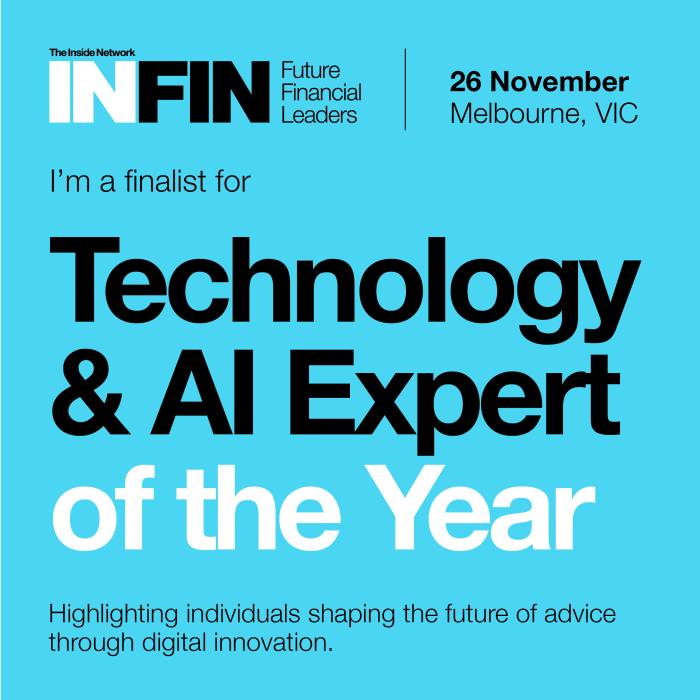
Luke Harlow Nominated for Technology/AI Expert Award
We are pleased to announce one of our financial advisers, Luke Harlow has been nominated in the INFIN: Future Financial Leaders 40 under 40 awards for 2025, as a finalist for Technology/AI Expert of the Year. We wish him luck next week.
Details of the event are here: https://www.theinside.network/infin-vic-2025

Responsible investing on the rise
For many people, there’s much more to choosing investments than focusing exclusively on financial returns. Returns are important, but a growing number of people also want to be assured that their investments align with their values.
Everyone’s values are different but given the choice most people would wish to make a positive difference to their community and/or the planet. Or at least to do no harm.
Indeed, four out of five Australians believe environmental issues are important when it comes to their investment decisions.i
As a result, there has been a surge in what is called responsible investing. Also known as ethical or sustainable investing, responsible investing is pretty much what it says on the label. That is, investments that support and benefit the environment and society more broadly, rather than those whose products or way of conducting business have a negative impact on the world.
Millennials driving growth in sustainability
The trend toward responsible investment has grown rapidly in recent times. According to the Responsible Investment Association of Australasia (RIAA), Australians invested $1.2 trillion in responsible assets in 2020, and we’re not alone.ii The global figure was $47.8 trillion in 2020.iii
The trend has accelerated in recent years, with money flowing into Australian sustainable investment funds up an estimated 66 per cent in the year to June 2021.iv
Responsible investing is particularly popular among millennials, now in their late 20s and 30s and beginning to get serious about building wealth. Many in this group are getting a foot on the investment ladder via exchange-traded funds (ETFs). A recent survey of the Australian ETF market found 28 per cent of younger investors had requested more ethical investments.v
More sustainable investment options
As awareness of responsible investing grows, so does the availability of sustainable investment options, beginning with your super fund.
Most large super funds these days offer a sustainable option on their investment menu. While relatively rare even 10 years ago, the availability and performance of sustainable options has grown strongly over the past three to five years.
According to independent research group, SuperRatings, the top performing sustainable options now surpass their typical balanced style counterparts in some cases.vi
If you run your own self-managed super fund (SMSF) or wish to invest outside super, there is a growing number of managed funds that actively select sustainable investments, or ETFs that passively track an index or sector.
There were 135 sustainable funds in Australia and New Zealand in 2021, so there is plenty of choice.iv
How to screen
But how do you find the ethical investments that best suit your values?
There are several methods used with the most common being negative screening where you exclude investments in companies engaged in unwelcomed activities.
The most common exclusions are companies involved in gambling, tobacco, firearms, animal cruelty, human rights abuses or fossil fuels industries.
Positive screening is the opposite, where you actively seek out investments in companies making a positive contribution to the planet. Some examples might be companies involved in renewable energy, health care or education.
Another criterion is to look at companies that monitor their environmental, social and governance risks as part of their existence. This cuts across all industries and is more about the way the company conducts its business.
Environmentally they may monitor their carbon emissions or pursue clean technology; socially they may be active in ensuring a safe workplace; and on the governance front they may pursue board diversity or anti-corruption policies.
Environmental themes the most common positive screens for investors

Source: RIAA
Climate plays a role
A survey by UBS found that four of the five top themes for responsible investing were related to climate with respondents citing such themes as renewable energy and efficiency, climate change mitigation and pollution prevention.vii
As the popularity of responsible investing grows, so do concerns about the practice of so-called greenwashing. This is where a company or fund overrepresents the extent to which its practices live up to their promises. The Australian Securities and Investments Commission (ASIC) recently announced a review into the use of greenwashing in Australia, prompted in part by the demand for such funds.
Another trend is impact investing in companies or organisations helping to finance solutions to some of society’s biggest challenges. This might include investments in areas such as affordable housing or sustainable agriculture.
At the end of the day, each method can be used separately or in a more holistic approach.
Solid returns
While some investors are driven by their values alone, many more want value for their money. The good news is that it’s possible to have it both ways.
The RIAA survey found super funds that engage in responsible investments outperformed their peers over one, three and five years. While the top performing ethical ETF turned in an impressive return of almost 37 per cent in the 12 months to March 2021.i
Clearly responsible investing is a trend that is gaining momentum, with the financial performance of sustainable investments attracting a wider following.
If you would like to discuss your investment options and how they might fit within your overall portfolio, don’t hesitate to get in touch.
i https://www.canstar.com.au/investor-hub/ethical-investing/
ii https://responsibleinvestment.org/resources/benchmark-report/
iv https://www.morningstar.com.au/funds/article/australias-sustainable-funds-market-is-growin/214505
Buachailli Pty Ltd ABN 57 115 345 689 atf Harlow Family Trust t/as Queensland Financial Group is a Corporate Authorised Representative of Synchron AFS Licence No. 243313 This advice may not be suitable to you because it contains general advice that has not been tailored to your personal circumstances. Please seek personal financial advice prior to acting on this information. Investment Performance: Past performance is not a reliable guide to future returns as future returns may differ from and be more or less volatile than past returns.